
Guide to Compressed Air Filtration: OEM vs. Aftermarket
The Ultimate Guide to Compressed Air Filtration: OEM vs. Aftermarket
Featuring Atlas Copco Part Number Comparisons (1613-8720-00 vs. 1613872000-AM)

In the world of industrial machinery, few systems are as critical—or as ubiquitous—as the air compressor. Often referred to as the “fourth utility” after electricity, water, and natural gas, compressed air powers everything from heavy automated manufacturing plants to local automotive repair bays. Yet, the ongoing reliability, energy efficiency, and operational lifespan of any compressed air system hinge heavily on a strict preventative maintenance regimen and the quality of its replacement parts.
For fleet managers, maintenance technicians, and business owners alike, one question constantly arises during scheduled service intervals: Should we buy Original Equipment Manufacturer (OEM) parts, or opt for high-quality Aftermarket alternatives?
In this comprehensive guide, we will break down the fundamental differences between OEM and aftermarket solutions. To make this comparison concrete, we’ll examine two specific air filter elements: the OEM Atlas Copco 1613-8720-00 and its direct aftermarket counterpart, the 1613872000-AM. Along the way, we’ll show you how to navigate product listings, decode part numbers, and optimize your maintenance budget without sacrificing system integrity.
1. Setting the Stage: The Heart of Your Pneumatic Infrastructure
Before diving into the filtration debate, it’s important to understand the role compressed air plays and why clean air matters. Industrial air compressors—whether rotary screw, reciprocating piston, or centrifugal models—work by taking large volumes of ambient air and compressing it into a smaller space.
This mechanical process generates the energy that drives pneumatic systems. Pneumatics is the branch of engineering that uses pressurized gas to create mechanical motion. In industrial environments, this powers many applications:
- Automated Assembly Lines: Pneumatic cylinders, actuators, and grippers move parts along conveyor systems with precision.
- Industrial Power Tools: Impact wrenches, grinders, sanders, and nail guns rely on consistent pneumatic pressure.
- Material Handling & Packaging: Vacuum systems and air-driven lifts handle packaging and product movement.
- Spray Painting & Surface Coating: Constant pressure ensures smooth paint and coating application.
- Food, Beverage, and Pharmaceuticals: Clean compressed air supports sensitive processes where contamination is unacceptable.
The Vulnerability of the System: Wear Parts and Replaceables
Because an air compressor pulls in surrounding air, it also collects dust, moisture, and airborne contaminants. Inside the machine, friction, heat, and oil carryover create additional stress.
Compressors rely on several wear parts and replaceable components that require routine maintenance:
- Air Filters: Prevent dust and debris from entering the compression chamber.
- Oil Filters: Remove contaminants from compressor lubricant.
- Air/Oil Separators: Remove oil mist from compressed air in lubricated rotary screw compressors.
- Inline Coalescing Filters: Remove moisture, oil droplets, and fine particles downstream.
- Belts, Gaskets, and Valve Seals: Components exposed to heat, pressure, and friction.
When these components are not replaced on schedule, pressure drops occur, forcing the compressor to work harder and increasing energy costs and internal wear.
2. Navigating the Compressor Now Website: How to Read Our Product Listings
At Compressor Now, we designed our catalog to make sourcing compressor parts simple and transparent. Understanding product listings helps reduce downtime and ensures you receive the correct replacement component.

Here is how to identify the right parts:
- The Exact Part Number Matching System: Manufacturer part numbers are critical. Search using exact numbers, with or without dashes or spaces, to quickly find matching products.
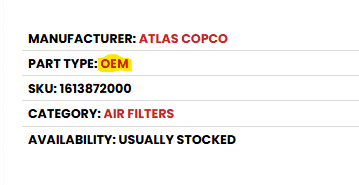
OEM product description - The “-AM” Suffix Explained: When you see a part number ending in “-AM,” it identifies an aftermarket replacement product. This makes it clear what you are purchasing.
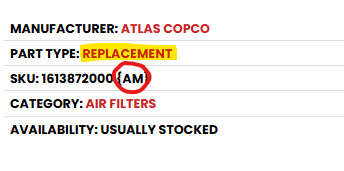
AM Product Description - Cross-Referencing Specifications: Product listings include dimensions, compatibility information, and filtration ratings to help ensure proper fitment.


3. Case Study: OEM vs. Aftermarket Air Filters
To see these principles in action, let’s compare two air filter elements available from Compressor Now:
- The OEM Model: Air Filter Element 1613-8720-00
- The Aftermarket Model: Atlas Copco Air Filter Part 1613872000-AM
What is an OEM Part?
An OEM (Original Equipment Manufacturer) filter is manufactured directly by or specifically for the original compressor manufacturer. It typically includes factory branding, packaging, and specifications approved by the equipment manufacturer.
- Pros: Guaranteed factory specifications, documented compatibility, and alignment with OEM maintenance requirements.
- Cons: Higher cost, possible supply chain delays, and potential backorders on older equipment models.
What is an Aftermarket Part?
An aftermarket filter is produced by an independent manufacturer specializing in replacement components. These parts are engineered to match the original filter’s dimensions, performance requirements, and filtration efficiency.
- Pros: Lower cost, improved availability, and reduced downtime when OEM parts are delayed.
- Cons: Does not carry the original manufacturer branding and quality depends on the supplier.
Pro Tip: All of Compressor Now’s aftermarket suppliers are carefully vetted to ensure consistent quality, reliability, and performance.
Side-by-Side Comparison Matrix
| Feature / Metric | OEM Element (1613-8720-00) | Aftermarket Element (1613872000-AM) |
|---|---|---|
| Physical Dimensions | Built to exact factory specifications for Atlas Copco housings. | Manufactured to match original dimensions and fitment requirements. |
| Filter Media Quality | Factory-selected media designed for OEM airflow requirements. | High-quality filtration media designed to meet or exceed required performance. |
| Micron Rating | Matches the original filtration rating. | Designed to provide equivalent filtration efficiency. |
| Price Point | Higher cost due to OEM branding and distribution channels. | More cost-effective alternative with reduced maintenance expenses. |
| Warranty Considerations | Often preferred for warranty documentation and compliance. | Generally suitable when properly matched and sourced from a reliable supplier. |
4. The Operational Benefits of Aftermarket Parts
While price savings are often the first reason companies consider aftermarket parts, the advantages extend beyond cost reduction.
Keeping Aging Compressor Fleets Running
Industrial compressors are designed for long service lives. Many machines continue operating for decades with proper maintenance. However, OEM manufacturers may eventually discontinue support for older models.
Aftermarket suppliers help maintain these legacy machines by continuing to provide replacement filters and components long after OEM availability declines.
Reduced Lead Times and Improved Availability
Downtime is one of the largest costs in any manufacturing environment. A missing filter can take a compressor offline and interrupt production.
Aftermarket suppliers often maintain flexible manufacturing and distribution networks, helping facilities avoid extended OEM backorders and keep equipment operating.
5. Summary: Choosing Between OEM and Aftermarket
Choosing between OEM and aftermarket filters depends on your equipment, operating requirements, and maintenance goals.
- Choose OEM (1613-8720-00) if: Your equipment requires factory-branded components, warranty documentation, or strict compliance with manufacturer guidelines.
- Choose Aftermarket (1613872000-AM) if: You want to reduce maintenance costs, extend the life of older equipment, or need a faster replacement option.
Understanding product listings and recognizing the “-AM” designation helps you make informed decisions when purchasing compressor parts.
6. Ready to Optimize Your Compressed Air System? Contact Compressor Now!
Whether you need OEM components or cost-effective aftermarket alternatives, Compressor Now helps you find the correct products for your compressed air system.
Our team can cross-reference parts and provide fast quotes to keep your operation running.
- Email:[email protected]
- Phone: 888 727-8714
- Website: compressornow.com
Let Compressor Now keep your air clean, your tools powered, and your operations running smoothly.