
Oil-Injected vs Oil-Free Air Compressors: Which Is Right?
Compressor Now2026-07-02T10:14:33-07:00Oil-Injected vs. Oil-Free: Which One Does Your Industry Actually Require?
Choosing between an oil-injected and an oil-free air compressor is not just a technical decision—it is a financial and operational one. The wrong choice can lead to contaminated product batches, unexpected downtime, higher maintenance costs, or unnecessary capital expense that continues to drain your budget over time.
At Compressor Now, we focus on matching the machine to the mission. Every industry has different air quality requirements, duty cycles, and risk tolerances. Understanding how each compressor technology works is the first step toward making the right long-term investment.
What Is an Air Compressor Used For?
Air compressors are machines that convert mechanical energy into stored compressed air. That compressed air is then used as a versatile power source across industrial, commercial, and specialized applications.
Compressed air is often considered the “fourth utility” in modern facilities because of how widely it is used.
Common applications include:
- Pneumatic tools such as impact wrenches, grinders, and drills
- Manufacturing and assembly line operations
- Automated machinery and robotics
- Painting, coating, and finishing systems
- Food packaging and production equipment
- Medical and laboratory air systems
- Electronics and precision manufacturing
- Construction and heavy equipment tools
Because compressed air directly supports production, choosing the correct compressor type is critical to both performance and product quality.
1. Oil-Injected (Oil-Flooded) Compressors
The Workhorse of Industry
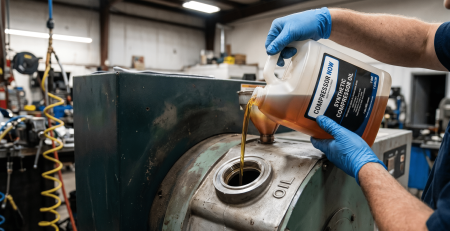
Oil-injected compressors use oil inside the compression chamber to lubricate moving parts, seal internal clearances, and absorb heat generated during compression. After compression, the air is separated and filtered, though trace amounts of oil (measured in parts per million) may still remain.
These systems are designed for durability, continuous operation, and general industrial use where ultra-pure air is not required.
Best For:
Rugged, continuous-duty applications where air quality must be good but does not need to be sterile or oil-free.
Common Industries:
- General manufacturing
- Construction and mining
- Automotive repair and service shops
- Metal fabrication and machining
Advantages:
- Lower initial purchase cost
- Long service life under proper maintenance
- Highly durable in demanding environments
- Efficient cooling through oil lubrication
Disadvantages:
- Requires regular oil and filter maintenance
- Condensate disposal is necessary
- Trace oil carryover possible without proper filtration
2. Oil-Free Compressors
The Gold Standard for Air Purity
Oil-free compressors are designed so that no oil ever enters the compression chamber or air stream. They use advanced coatings, precision engineering, or alternative cooling methods such as water injection or dry running components to eliminate internal lubrication needs in the compression process.
These systems are built for environments where even the smallest amount of contamination could compromise product safety or equipment performance.
Best For:
Applications where air purity is critical and contamination is not acceptable under any circumstances.
Common Industries:
- Food and beverage production
- Pharmaceutical manufacturing
- Medical and dental facilities
- Electronics and semiconductor production
- Cleanroom environments
Advantages:
- Zero risk of oil contamination
- Meets stringent air purity standards (including ISO Class 0 applications)
- Eliminates oil disposal requirements
- Ideal for regulated industries
Disadvantages:
- Higher upfront capital cost
- More specialized maintenance requirements
- May operate at higher noise levels depending on design
Quick Comparison Table
| Feature | Oil-Injected | Oil-Free |
|---|---|---|
| Initial Cost | Lower | Higher |
| Air Purity | High (with filtration) | Absolute (ISO Class 0 capable) |
| Maintenance | Regular oil and filter changes | Specialized service intervals |
| Noise Level | Generally quieter | Can be higher depending on design |
| Risk Factor | Potential oil carryover | No oil contamination risk |
Which One Does Your Industry Require?
The decision between oil-injected and oil-free compressors ultimately comes down to risk versus cost efficiency.
If you are operating a general manufacturing facility or furniture production shop, an oil-injected system is often the most cost-effective solution. With proper filtration, the air quality can be sufficient for most production and finishing processes.
However, if you are working in food production, pharmaceuticals, medical environments, or any application where contamination could impact safety or compliance, oil-free is not optional—it is required.
In these environments, even trace contamination can lead to product rejection, compliance violations, or serious liability concerns.
Total Cost of Ownership Matters
When evaluating compressor systems, the initial purchase price should not be the only consideration. The total cost of ownership includes:
- Energy consumption over time
- Maintenance and service intervals
- Filter and consumable replacement costs
- Downtime risk and production impact
In some cases, a higher upfront investment in oil-free technology can reduce long-term risk and operating costs. In others, an oil-injected system provides the best balance of performance and affordability.
Summary
Oil-injected and oil-free compressors serve very different roles in industrial operations. Oil-injected systems offer durability, lower upfront cost, and strong performance for general industry applications. Oil-free systems provide absolute air purity for sensitive environments where contamination is not acceptable.
Choosing the right technology depends on your industry requirements, air quality standards, and long-term operating goals.
Understanding your application is the key to selecting a compressor that performs efficiently while protecting your process, your equipment, and your bottom line.
Need Help Choosing the Right Compressor?
Compressor Now can help you evaluate your application and recommend the right oil-injected or oil-free system for your specific industry needs.
Contact our team today for guidance, product information, or sales support. We are here to help you build a reliable and efficient compressed air system.