
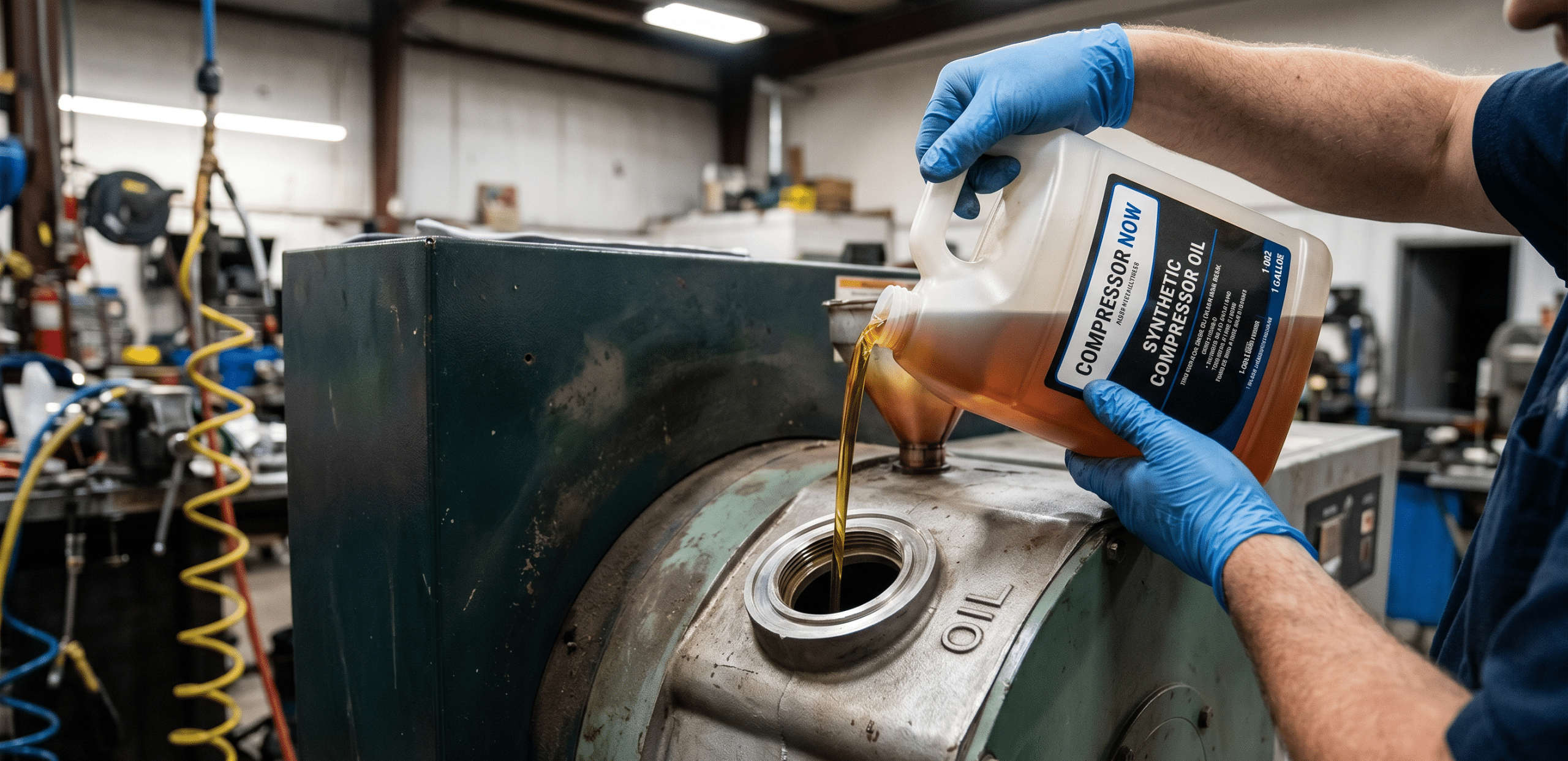
The Lifeblood of Your System
Compressor Now2026-07-01T11:00:44-07:00The Four Core Jobs of Compressor Oil
Before we break down the chemistry, it helps to understand what the oil is actually trying to accomplish inside your compressor (especially in rotary screws)
- Lubrication: Minimizing friction between moving parts (like rotors and bearings) to prevent wear.
- Cooling: Absorbing and carrying away the massive amount of heat generated during the air compression process.
- Sealing: Creating a microscopic fluid seal between the rotors to prevent compressed air from escaping back into the intake.
- Cleaning: Picking up particulates and carrying them to the oil filter to keep the internal system pristine.
To achieve all of this simultaneously, modern compressor oil relies on a delicate balance of two main elements: Base Oils and Additives.
Deep Dive: The Base Oils
The base oil makes up the vast majority of the fluid in the drum (usually between 80% and 90%). It is the foundational carrier that does the heavy lifting for lubrication and cooling. There are three main categories of base oils used in air compressors:
1. Mineral Oils
Refined directly from crude oil, mineral oils are the traditional, entry-level option. They are generally less expensive upfront. However, because their molecular structure is somewhat inconsistent, they tend to break down faster under high heat, leading to carbon build-up and varnish.
- Best for: Light-duty or intermittent use compressors, or older reciprocating models.
- Lifespan: Typically 1,000 to 2,000 hours.
2. Synthetic Oils
Synthetic base oils are chemically engineered in a laboratory. Because their molecules are uniform in size and shape, they offer drastically less friction, superior heat transfer, and exceptional resistance to oxidation (breaking down). Common synthetic bases include Polyalphaolefins (PAO), Polyalkylene Glycols (PAG), and Polyol Esters (POE).
- Best for: Heavy-duty, continuous-use rotary screw compressors and extreme temperature environments.
- Lifespan: Can range from 4,000 to 8,000+ hours.
3. Semi-Synthetics
As the name suggests, this is a blended middle ground. By mixing mineral oil with a synthetic base, manufacturers create a fluid that offers better performance and lifespan than straight mineral oil, but at a lower price point than a full synthetic.
Ready to upgrade your system’s lifeblood? Browse our full selection of compressor oils or contact our team today to find the perfect chemical formulation for your specific machine.